
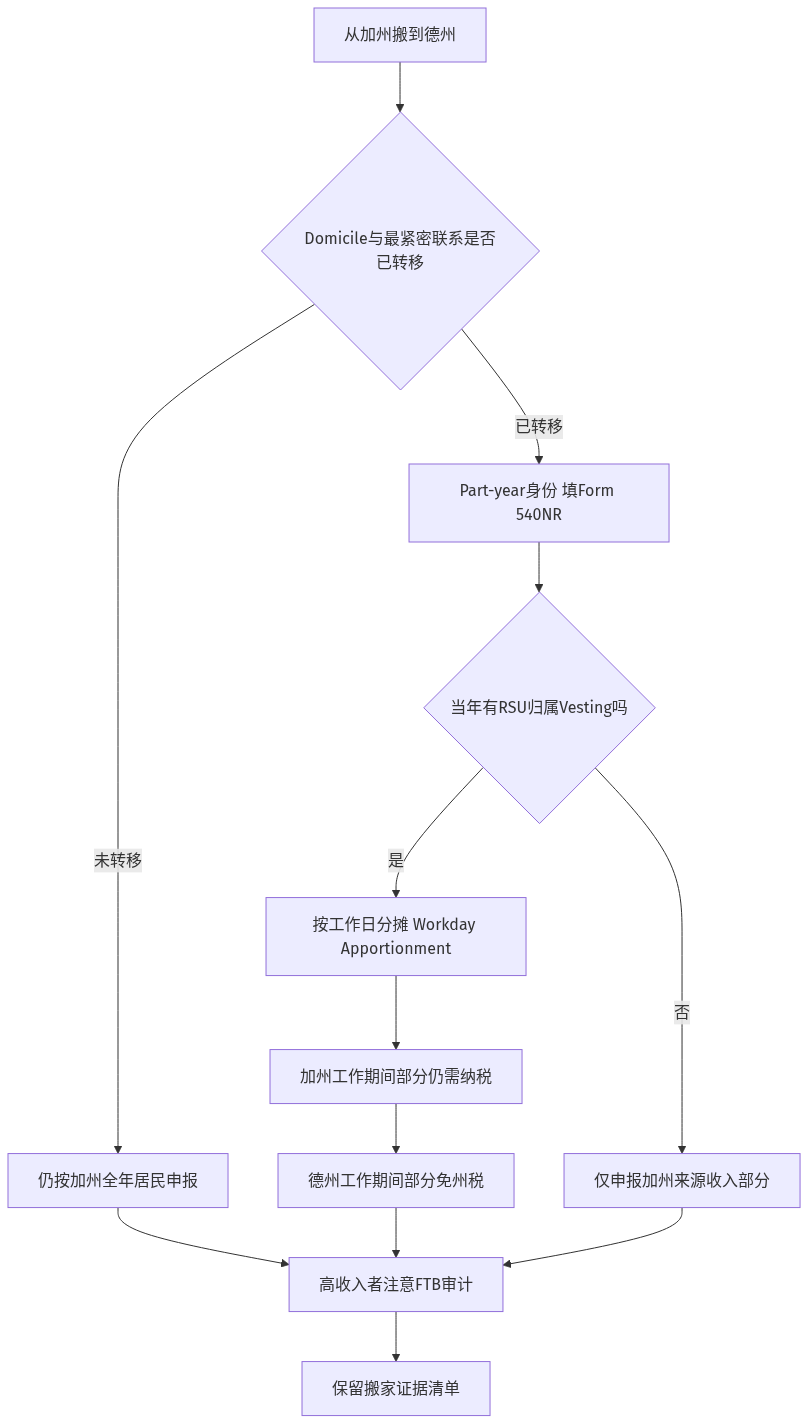
The short answer: in the year you move, you'll typically still need to file California's Part-Year Resident return, Form 540NR. California residency is determined by domicile and closest connections — not your driver's license or mailing address. And after you leave California, the portion of your RSUs that vested based on work performed while you were a California employee can still be taxed by California on an allocated, workday basis. Many clients who move from California tech companies to Austin assume that once they've physically left, California no longer has any claim on them — and this is exactly the misconception that gets people into trouble during an audit.
Do You Actually Need to File Form 540NR in the Year You Move?
If you were a California resident for any part of the year before shifting the center of your life to Texas, the California Franchise Tax Board (FTB) generally requires you to file as a part-year resident using Form 540NR. This form splits the year into two segments: during the period you were a California resident, your worldwide income must be reported to California; after you become a nonresident, only California-source income needs to be reported. Texas itself has no state personal income tax, so wages, investment income, and similar earnings from the Texas portion of the year won't create additional state tax liability — but that doesn't mean the California-period income can simply be ignored.
The most common mistake in practice is when clients draw a hard line based on their physical move date, assuming "I arrived in Texas on such-and-such date, so nothing after that counts as California income." What the FTB actually examines isn't the date you signed your Texas lease, but the true source and earning period of each type of income — and equity compensation in particular often vests over several quarters or even years spanning the move, requiring separate allocation calculations rather than a simple cutoff like wages. This is exactly why many Chinese-American clients filing their first return after moving to Austin end up underestimating their California tax liability.
Why Can California Still Tax You? The Domicile and Closest Connections Test
California's determination of whether you're still a tax resident hinges on two core concepts: domicile (your legal permanent home) and closest connections. Domicile isn't about where you physically are — it's about where you intend to permanently settle, with no plan to leave. Even if you've already lived in Austin for most of the year, if you still own your California home and haven't sold it, your family remains in California, or you still plan to move back in a few years, the FTB has every reason to argue that your domicile has never actually shifted.
The closest connections test is broader and more holistic. The FTB will weigh a range of lifestyle indicators together, including where your driver's license and vehicle are registered, where you're registered to vote, where your real property is located, where your spouse and children live, where your bank and brokerage accounts are held, where your regular doctors and dentists are, and where your professional licenses are registered. No single factor is decisive on its own, but together they form an overall picture. Many clients assume that switching to a Texas driver's license and updating their address is enough — but in reality, if the California home hasn't sold, the spouse and kids are still enrolled in California schools, and the primary bank accounts remain in California, the FTB can very reasonably argue in an audit that you remained a California resident for most of that year. This kind of residency determination is a point emphasized repeatedly in our Chinese Tax Filing Guide, because it directly determines which forms you file and your taxable base.
RSUs Earned During Your California Work Period Are Still Taxable After You Move
This is where clients moving from California tech companies to Texas most often get tripped up. The taxable event for RSUs (restricted stock units) occurs on the vesting date, but California doesn't simply look at where you were physically located on that date — it looks at how many of the workdays across the entire vesting period were performed in California, and allocates its taxing right proportionally based on that workday ratio. For example, if an RSU grant has a four-year vesting schedule, and you worked in California for three of those years before moving to Austin and working the fourth year there before the shares vest, California still has the right to tax roughly three-quarters of that equity income — the portion corresponding to your California work period — even though you were physically in Texas on the vesting date itself.
This same rule applies to other forms of deferred compensation, such as certain bonus plans and stock option exercise income — as long as the earning period for that income spans the time you worked in California, California may assert a partial taxing right allocated by workdays. One important clarification: the "safe harbor" rule under the 546-day overseas employment contract only applies to specific foreign expatriate assignments meeting certain conditions, and it cannot be applied to an intrastate move like relocating to Texas — a misunderstanding we see frequently in client consultations. For clients holding significant unvested RSUs who are planning to leave California, we strongly recommend putting together a vesting schedule and workday log before the move, to make it easier to calculate the allocation ratio later. For more detail on the mechanics involved, see the equity compensation breakdown in our Tax Insights column.
Why Does the FTB Target High-Income Movers, and What Evidence Should You Keep?
The FTB is notoriously strict when auditing the residency status of high earners who leave California, for a simple reason: if a tech professional earning several hundred thousand dollars — or more — a year is determined to have still been a California resident that year, the back taxes and penalties can be substantial, making these audits highly cost-effective for the state. Such audits often trace your life patterns for a year or two before and after the move, comparing details like your driver's license, voter registration, real estate transaction records, utility bills, proof of your children's school enrollment, and the timing of address changes on bank statements. Any inconsistency in these timelines can become grounds for the FTB to argue that your domicile never actually shifted.
- Home purchase, sale, or lease documents, including the sale or lease date of your California property
- Account opening dates for Texas utility, electricity, and internet bills
- Proof of your children's school transfer or new school enrollment
- Records of changes to your driver's license, vehicle registration, and voter registration
- Address change records and primary usage location for bank and brokerage accounts
- Your RSU vesting schedule along with corresponding work location and workday records
We recommend that clients start organizing this documentation systematically in the very year the move happens, rather than scrambling to reconstruct evidence years later after receiving an FTB inquiry. If you still hold foreign bank or investment accounts while a California resident, don't forget to check our FBAR Filing Guide to confirm whether your reporting obligations are affected by the change in residency status.
YZ CPA Note
Filing your first return after moving from California to Texas is far more involved than "file a 540NR and treat everything else as tax-free under Texas's zero state income tax." When we handle these cases for our Chinese-American clients in Austin, we typically start by reconstructing the full timeline of domicile and closest connections, then separately calculate the portion of RSUs and other deferred compensation subject to California tax based on workday allocation — helping clients avoid having the FTB come back years later for back taxes and penalties due to a misjudged residency status or a missed allocation calculation. If you're moving this year and hold a significant amount of unvested equity, we strongly recommend having a professional run a residency and allocation analysis before you file, rather than waiting until an FTB notice arrives to react.
For professional tax assistance, please visit our YZ CPA Services page or contact us.