
Your parents wire you money from China to buy a house? Several relatives each send small amounts to help cover your down payment? Dividends from an overseas company land in your US account? Most Chinese Americans have no idea what the compliance requirements are for these cross-border money flows — especially when it comes to Form 3520, whose penalty for failing to file runs 25%–35% of the gift amount, even harsher than the FBAR penalty. This article walks through real-world scenarios: what you need to report, what you don't, and how to avoid getting burned. It's a companion piece to our FBAR Filing Guide, and we recommend reading it alongside our Complete Tax Filing Guide for Chinese Americans.
First, remember one core fact: Form 3520 is not an income tax return — receiving a gift itself is not taxable. But the penalty for failing to file it is 25%–35% of the gift amount. To put a number on it: if your parents give you $200,000 for a home down payment and you don't file Form 3520, the IRS can fine you up to $50,000 if it catches the omission. Even worse, under §6501(c)(8) of the tax code, as long as Form 3520 has never been filed, the statute of limitations for that tax year never starts running — meaning the IRS can theoretically go back and assess at any time, with no deadline. The chart below walks through what to do when you receive money from overseas:
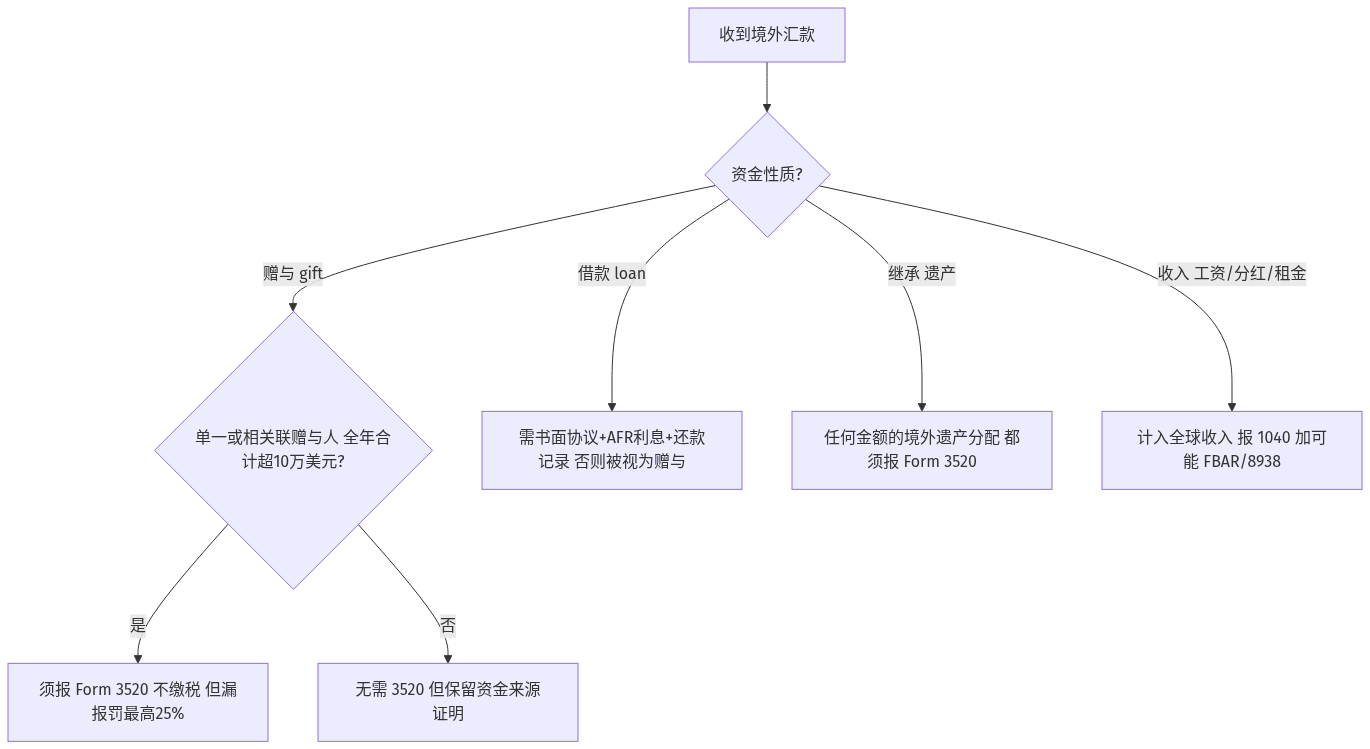
Step One: Distinguish the Four Types of Cross-Border Transfers
Not all wire transfers are the same. The nature of the funds determines whether you owe tax, whether you need to file a report, and which form to use:
| Nature | Source | US Recipient Owes Income Tax? | US Filing Obligation |
|---|---|---|---|
| Gift | Parents / Relatives / Friends (individuals) | No | Form 3520 (single year > $100,000) |
| Loan | Anyone | No (a loan is not income) | Generally none |
| Inheritance | Estate of a deceased relative | No | Form 3520 (> $100,000) |
| Income | Chinese employer / company dividends / rent | Yes | Form 1040 + possibly Form 8938 + FBAR |
The category most easily confused is the "loan." If your parents "loan" you $50,000 to buy a car, but there's no written loan agreement, no stated interest rate, and no record of repayment, the IRS is likely to treat it as a "disguised gift." To be genuinely recognized as a loan, you need: a written loan agreement, an interest rate at or above the IRS's monthly published Applicable Federal Rate (AFR), and an actual repayment record. Otherwise, if it's reclassified as a gift, you won't be able to avoid the penalty plus interest.
Form 3520: The Most Expensive Form to Miss
You must file Form 3520 if any of the following apply:
- You receive gifts totaling more than $100,000 in a single year from the same foreign individual;
- You receive gifts totaling more than $100,000 in a single year from multiple related foreign individuals combined (to prevent splitting transfers to avoid the threshold);
- You receive any amount distributed from a foreign trust;
- You receive any amount distributed from a foreign estate (inheritance);
- You own a foreign trust or transfer property to one.
Edge cases that don't trigger the requirement but are easy to trip over: if your father wires $50,000 and your mother wires $60,000 — totaling $110,000 (parents count as related persons) — the amounts must be combined, triggering the filing requirement. But if your father wires $99,000 and an unrelated friend wires $99,000, since these don't fall under the aggregation rule and neither single source reaches $100,000, no filing is triggered. Key filing points: Form 3520 is an information return — you don't owe tax on it — and its deadline matches your Form 1040 (April 15). Note that it does not automatically extend — its deadline only pushes to October 15 if you file an extension (Form 4868) for your Form 1040. It must be mailed separately to the IRS's Ogden processing center.
The penalty for failing to file is the real concern: failing to report gifts over $100,000 carries a penalty of 5% per month, capped at 25% of the gift amount; failing to report trust distributions carries a 35% penalty. For example: if your parents wire you $300,000 in a given year and you don't file Form 3520, and the IRS catches it the following year, the penalty = $300,000 × 25% = $75,000 — even if the money is entirely legitimate and compliant, the penalty still applies.
Parents Covering Your Home Down Payment: The Most Common Scenario
For Chinese Americans buying homes in Austin, Houston, or the Bay Area, seven or eight out of ten cases involve a gift from parents. A few typical scenarios:
- Your parents wire you $250,000 directly: a single source exceeding $100,000 requires filing Form 3520; no income tax is owed; keep documentation of the source of funds (your parents' wages, savings, or a home sale contract from prior years) — the IRS occasionally audits the source of funds.
- Your father wires $90,000 and your mother wires $90,000, totaling $180,000: since parents are related persons, the combined $180,000 requires filing.
- Five relatives each wire $30,000, totaling $150,000: if the five are unrelated to each other (cousins, friends), each is below $100,000 and doesn't trigger aggregation; however, the IRS may view this as "structuring to avoid reporting," which carries higher risk — we still recommend filing. If all five are immediate family members, the amounts must be combined and filing is required.
- You receive $300,000 from your parents and your spouse receives $200,000 from their parents: you file your own Form 3520 for your $300,000, and your spouse files a separate Form 3520 for their $200,000 — spouses are calculated separately and cannot be combined.
There's also a practical reality on the China side: China's State Administration of Foreign Exchange (SAFE) limits individual foreign currency purchases to $50,000 per person per year. To transfer larger amounts, parents often split the funds across multiple family members' accounts — for example, "father $50,000 + mother $50,000 + grandparents $50,000 each = $200,000" (sometimes called "ants moving house"). This is compliant on the China side, but on the US side the amounts must be aggregated in US dollars — don't assume that splitting across accounts in China means you're off the hook in the US. Form 3520 looks at the total combined amount, not the number of accounts used on the China side.
Whose Responsibility Is It: The Recipient's, Not the Sender's
Form 3520 is the responsibility of the recipient (the US person), not the parents sending the money. Your parents in China have no IRS filing obligation (they are not US persons), but you, as a US person, must file when you receive a gift. One exception: if you're still a nonresident (for example, an F-1 student who's been in the US less than 5 years), you're not a "US person," and technically you don't need to file Form 3520 — but the obligation begins the year you become a tax resident.
How to Handle WeChat, Alipay, Zelle, and Cryptocurrency
In recent years, many Chinese Americans have used electronic payment platforms to receive cross-border funds, and the rules aren't quite the same as for traditional wire transfers:
- WeChat / Alipay: if the funds land in your US account, this triggers Form 3520 just like a wire transfer (if over $100,000); if the funds stay in your Chinese WeChat/Alipay account, that triggers FBAR (the balance counts as a foreign account), and combining multiple accounts may also trigger Form 3520.
- Zelle / Venmo (US domestic only): these don't support international transfers — the source of funds must be a US bank. If your parents wire money to your US account and you then send it to your spouse via Zelle, that's a domestic transfer, not a foreign gift.
- Bank wire transfer (SWIFT): the most common and traceable method — the bank keeps complete records, making it easy for the IRS to verify. If your parents wire from their Industrial and Commercial Bank of China (ICBC) account to your US bank, it will almost certainly be checked against the filing threshold.
- Cryptocurrency (USDT, etc.): if your parents buy USDT in China, transfer it to your US wallet, and you convert it back to dollars, it's still fundamentally a gift and still requires filing Form 3520. Lower traceability doesn't mean you're exempt — if it's ever discovered, the penalty will exceed the "non-willful" threshold, making the risk even greater.
Domestic Income in China: Rent, Dividends, and Wages Are Taxable
Unlike gifts, the following are income and are subject to US income tax:
- Rental income from property in China: rental income from a property you own in China is reported on Schedule E, where you can deduct depreciation, maintenance, property management fees, and property taxes; related taxes already paid in China can be claimed via the Foreign Tax Credit (FTC, Form 1116).
- Dividends from a company in China / Hong Kong: reported on Schedule B and Form 1040; dividend withholding tax paid in China can be claimed via the FTC.
- Employment income earned in China: if you're a US tax resident but you do project work for a Chinese company and the income is deposited into a Chinese account, you must still report it as worldwide income. Those who live abroad long-term (more than 330 days in a year) may use the Foreign Earned Income Exclusion (FEIE, Form 2555), with the exclusion amount adjusted annually for inflation as published by the IRS each year; but if you live in the US, you cannot use the FEIE and must rely on the Foreign Tax Credit instead.
What to Do If You Missed a Filing: Voluntary Disclosure Channels
Similar to FBAR, there are formal remedies available for a missed Form 3520 filing:
- Reasonable Cause exception: if you can show the failure to file was due to reasonable cause (you didn't know about the requirement, and it wasn't willful neglect), you can voluntarily file the missing returns along with a reasonable cause statement. The IRS's acceptance rate is uncertain, and the quality of the statement matters a great deal.
- Streamlined Filing Compliance Procedures: the same streamlined procedures that cover FBAR also cover missed Form 3520 filings — the offshore version can waive the penalty entirely, while the domestic (US-resident) version offers a significantly reduced penalty.
The most important practical point: once you discover a missed filing, act before the IRS comes looking — proactively filing under the streamlined procedures results in a far lower penalty than waiting for an audit and getting hit with the full 25%–35% of the gift amount. The earlier you act, the more options you have.
When to Bring in a Professional
- You or your parents are about to wire more than $100,000 to the US: planning ahead is far easier than fixing things after the fact — you can structure the funds flow and filing plan before the transfer happens, reducing audit risk.
- You have unreported large gifts from past years: the streamlined procedures or a reasonable cause statement are high-stakes documents — if written poorly and rejected by the IRS, you'll face the full penalty.
- You have ongoing income in China (rent / dividends / consulting): choosing between the FEIE and the Foreign Tax Credit can make a difference of several thousand dollars a year.
- You're planning to hold US assets through an LLC or trust: planning ahead is the only way to avoid a filing nightmare — don't expect a structure to help you avoid Form 3520. A single-member LLC is disregarded by default and is still treated as a gift to an individual.
FAQ: Filing Taxes on Wire Transfers from China
Q: My parents wired me $50,000 to buy a car — do I need to report it?
No income tax is owed (a gift isn't income), and it doesn't trigger Form 3520 (below $100,000). The bank may file its own large-transaction report when the money enters your US account, but that's the bank's responsibility, not yours.
Q: My parents + grandfather + grandmother each wired $40,000, totaling $120,000 — do I need to file Form 3520?
Yes. Related foreign persons are aggregated, and the combined total exceeding $100,000 triggers the requirement, even if the money is split across multiple people, accounts, or transfers.
Q: A friend (not a relative) wired me $50,000 from China to buy a house — do I need to report it?
A single source of $50,000 is below the $100,000 threshold, so it doesn't trigger the requirement. But the IRS treats a "loan from a friend" differently from a "gift from a friend" — if it's nominally a loan but never actually repaid, it may be reclassified.
Q: I have a rental property in China — is the rental income taxable in the US?
Yes. US tax residents report worldwide income. Rental income is reported on Schedule E, where you can deduct depreciation and expenses, and property taxes or income taxes already paid in China can be claimed via the Foreign Tax Credit.
Q: I received about $70,000 from my parents via WeChat/Alipay — how should I handle it?
If it lands in your US account, a single source below $100,000 doesn't trigger Form 3520; if it stays in your Chinese WeChat/Alipay account, it triggers FBAR (balance over $10,000); combining multiple accounts may also trigger Form 3520.
Q: I missed filing Form 3520 for 5 years — what should I do?
Immediately assess your eligibility for the streamlined filing procedures — the non-willful, US-resident penalty is calculated as a percentage of your peak offshore asset value, far lower than the 25%–35% of the gift amount the IRS assesses if it catches the omission on its own. Having a professional prepare your reasonable cause / non-willful certification is a critical step.
Q: My parents sold their house in China and wired me $500,000 — can I avoid tax on this?
You owe no tax on the gift itself; your parents pay Chinese tax on the home sale in China. A single source of $500,000 requires filing Form 3520, and you should keep source-of-funds documentation (the home sale contract, bank records) for at least 5 years.
Q: Can I have my parents wire the money to my LLC instead of my personal account to avoid Form 3520?
No. A single-member LLC is disregarded by default and is still treated as a gift to an individual; a multi-member LLC may involve different filing requirements (such as Form 5471), which is usually more complicated, not less. Don't try to structure your way around this.
YZ CPA Note
The most expensive mistake with cross-border funds is usually not "paying too much tax" — it's "failing to file a form that doesn't even owe tax." Form 3520 is exactly that kind of form: it generates no tax liability, yet failing to file it can cost you a quarter of the gift amount in penalties, and it leaves the statute of limitations for that entire tax year open indefinitely. As a firm that handles a large volume of Form 3520 filings for Chinese American clients every year, our recommendation is this: plan ahead before making a large transfer — it's far less stressful than fixing things afterward. If you already have a missed filing, moving quickly through the proper voluntary disclosure channels puts you in a stronger position.
If you'd like professional help planning cross-border transfers or handling a Form 3520 filing, visit our YZ CPA Services page or contact us. For more topics, see our Tax Insights section and Tax FAQ.