
The three most common pitfalls in tax filing for international students: first, not knowing that Form 8843 must be filed even with no income; second, having employers mistakenly withhold $2,000–$5,000 in FICA taxes during OPT and never applying for a refund; third, failing to take advantage of the exemptions under Article 20 of the US-China Tax Treaty (scholarships fully exempt, plus the first $5,000 of compensation for services exempt). This article walks through every stage — F-1, CPT, OPT, and H-1B — with practical forms and refund procedures.
Further reading: for the overall framework, see the Complete Chinese Tax Filing Guide; for overseas accounts, see the FBAR Filing Guide; for quick reference, see the Tax FAQ; and for a local perspective, see Austin Chinese Tax Filing 2026.
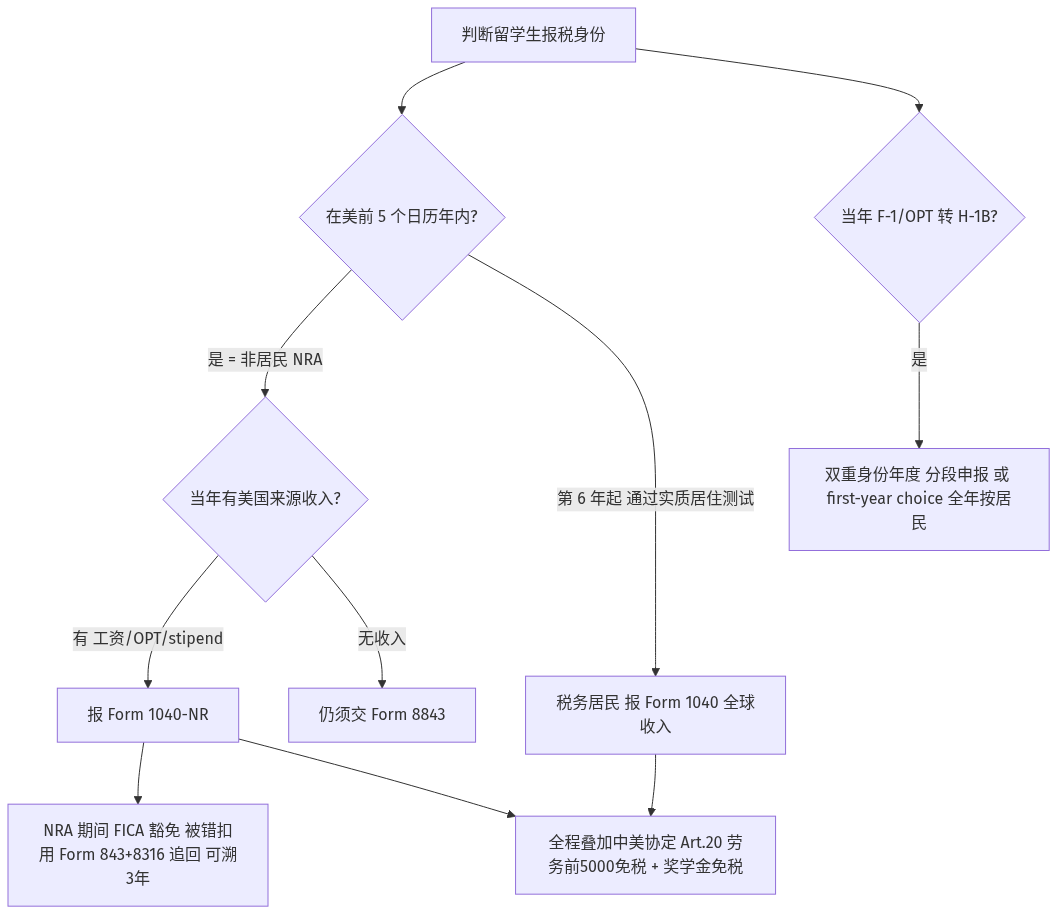
Every April, Chinese student group chats around UT Austin, Texas A&M, UH, and UTD light up with the same questions: Where do I file my F-1 tax return? Did my OPT employer wrongly withhold FICA taxes? How does dual status work in my first year of H-1B? The diagram below walks through the entire process of determining your status and choosing the right forms, before we break it down section by section.
The F-1 Five-Year Rule and the Mandatory Form 8843
The IRS uses the Substantial Presence Test (SPT) to determine whether you're a resident alien or a Nonresident Alien (NRA) for tax purposes. But F-1 and J-1 students get special treatment: for your first 5 calendar years in the US, you're treated as an "Exempt Individual," and those days don't count toward the SPT — so during those years you remain a nonresident. A few key details:
- It's 5 calendar years, not 5 consecutive years or 60 months. If you started school in 2024, you're a nonresident for the five calendar years from 2024 through 2028.
- Starting in your 6th year (e.g., 2029), the SPT applies, and you'll typically become a resident alien for tax purposes.
- Nonresident with US-source income → file Form 1040-NR (not Form 1040).
- Nonresident with no US income → you still must file Form 8843 to document your exempt status.
Form 8843 is a single page requiring only basic information, your school, days present in the US, and visa type. It's completely free, takes about five minutes to fill out, and is mailed to the IRS address designated for nonresidents (Austin, TX 73301-0215). About 80% of new Chinese students don't realize that Form 8843 must be filed even without income — international student offices usually mention this during orientation, but anyone who skips onboarding can easily miss it. Failing to file doesn't create a tax liability in the moment, but it does leave a gap in your compliance record that could be scrutinized later when applying for a green card or visa renewal.
FICA Refunds During OPT: The $2,000–$5,000 Most Commonly Withheld in Error
During OPT (Optional Practical Training), you're still on an F-1 visa, and as long as you're within the 5-year window, you remain a nonresident. Nonresident F-1 students are exempt from FICA taxes (6.2% Social Security + 1.45% Medicare, 7.65% total). The problem is that many company HR departments aren't familiar with this rule and default to withholding FICA as they would for any regular W-2 employee — OPT employees at Tesla, Apple, Samsung, and Oracle in Austin run into this frequently.
How do you check whether you've been wrongly withheld? Look at your pay stub or W-2: box 4 (Social Security tax withheld) and box 6 (Medicare tax withheld) should both be $0 — any amount there means you've been over-withheld. There are two paths to a refund, in order of priority:
- Path A — Get a refund directly from HR (fastest): Contact your employer's HR/Payroll department, provide copies of your F-1 visa, I-20, and EAD card, and cite IRS Publication 519's provisions on FICA exemption for nonresident F-1 students. If HR agrees, they'll refund the amount directly and issue a corrected W-2c, typically within 1–2 pay cycles. The downside is that HR often refuses, citing "company policy doesn't support this."
- Path B — Apply directly to the IRS (Form 843): Prepare Form 843 (Claim for Refund) plus Form 8316 (a statement that your employer won't refund the tax), and attach your W-2, pay stubs, visa documents, and a note explaining your employer's refusal, then mail everything to the IRS (Austin, TX 73301). This typically takes 6–12 months to process.
For example: an OPT employee at Tesla in Austin with $80,000 in W-2 wages had FICA wrongly withheld = 80,000 × 7.65% = $6,120, and received a full refund via Form 843 after about six months. One important note: the look-back period is only 3 years — if you've been wrongly withheld over multiple years of OPT and never filed a claim, act now, because refunds beyond 3 years can no longer be recovered.
CPT and On-Campus Employment
CPT (Curricular Practical Training) is a work authorization used during your studies, similar to OPT but typically shorter-term. Its tax treatment is the same as OPT's: during your nonresident period, it's treated as "Effectively Connected Income," it's likewise exempt from FICA, and any erroneous withholding can be recovered using the same process described above. As for on-campus employment, F-1 students are allowed to work up to 20 hours per week on campus (no EAD required); this income is treated as nonresident wages and is also FICA-exempt. School payroll usually doesn't withhold FICA, but occasional payroll errors do happen, so check box 4 and box 6 on your W-2 as well.
Dual Status in Your First Year of H-1B: The Most Complex Scenario
For many Chinese students, tax filing complexity peaks during the year they transition from F-1/OPT to H-1B — the "Dual-Status Year": within a single year, you're a nonresident for part of the year and a resident for the rest, and each period is filed under its own rules — the nonresident portion uses 1040-NR (allocating income proportionally to that period), and the resident portion uses 1040. Whether and when you switch from nonresident to resident depends on whether you accumulate 183 days of presence in the US that year:
- If your H-1B starts on October 1, you'd only have about 92 days (10/1–12/31) that year, so you remain a nonresident for the entire year and only become a resident the following year.
- If your H-1B starts at the beginning of the year and you're present in the US the entire year, you'd be a full-year resident in that first year.
A dual-status year comes with several special restrictions: you can't file jointly with your spouse (unless you make the "First-Year Choice" election described below to be treated as a resident for the full year); you can't take the standard deduction for the nonresident portion — only itemized deductions are allowed; and foreign income isn't reported for the nonresident portion, while worldwide income must be reported for the resident portion. General tax software (TurboTax, FreeTaxUSA) assumes you have the same status all year and can't handle these rules, so for your first year of H-1B, we strongly recommend working with a professional.
Another option is the "First-Year Choice Election": you can elect to be treated as a resident for the entire year you start H-1B, which unlocks married filing jointly and the standard deduction — at the cost of having to report your worldwide income for the full year. This election works out better in roughly half of cases, so it's worth calculating the actual break-even point before deciding.
US-China Tax Treaty Article 20: Full Exemption for Scholarships, Plus the First $5,000 of Compensation Exempt
Many Chinese students aren't aware of this treaty benefit and end up overpaying several hundred dollars in taxes every year for nothing. Article 20 has two provisions that are often conflated:
- Article 20(b): Scholarships, fellowships, and research grants (with no service obligation) received by Chinese students (F, J, or M visa) — fully exempt from federal tax, with no dollar limit.
- Article 20(c): Personal service income (wages, including compensation with a service obligation such as teaching assistant or research assistant pay) — the first $5,000 per year is exempt from federal tax.
Both provisions apply throughout your entire course of study, and you can keep using them even after becoming a resident for tax purposes. How to claim it: during the nonresident period, enter the treaty exemption in the appropriate field on 1040-NR; after becoming a resident, enter negative $5,000 on Schedule 1, line 8z of Form 1040 and note "US-China tax treaty Article 20"; in both cases, attach Form 8833 (Treaty-Based Return Position Disclosure). Many PhD students receive all their funding through RA/TA stipends with a service obligation (reported as W-2 wages), which fall under the $5,000 cap in 20(c) and can be claimed every year; if the funding is a pure fellowship (no service obligation), it falls under 20(b) and isn't subject to the $5,000 limit. This $5,000 figure was fixed when the treaty was signed in 1984 and hasn't been adjusted for inflation, but claiming it each year can still save you several hundred to over a thousand dollars in federal tax.
Applying for an ITIN: For Family Members Without an SSN
You'll need to apply for an ITIN (Individual Taxpayer Identification Number) for a family member in the following situations: your spouse doesn't have an SSN (H-4 visa holders often don't have work authorization) but you want to file jointly; you want to claim a child or dependent without an SSN on your return; or you yourself are a nonresident without an SSN but have US-source income. The application uses Form W-7, submitted along with a complete tax return and passport (original or certified copy). There are three ways to apply:
- Mail to the IRS: the slowest option (6–12 weeks), and you have to mail your original passport, which risks getting lost.
- Through a Certifying Acceptance Agent (CAA): most CPAs are IRS-certified CAAs who can verify your passport in person, so you don't have to mail the original.
- In person at an IRS Taxpayer Assistance Center (TAC): the Austin TAC is located at 825 E Rundberg Lane and requires an appointment. In practice, this is the fastest route — one client received their ITIN in just 3 weeks.
Useful Tax Filing Resources
- Authoritative guidance: IRS Publication 519 (Tax Guide for Aliens), and the official instructions for Form 1040-NR and Form 8843.
- School resources: UT Austin's International Student Office provides Glacier Tax Prep (GTP) — free tax software for nonresidents; most other schools such as Texas A&M, UH, and UTD also offer GTP or student discounts for Sprintax.
- Filing tools: Sprintax (most commonly used by nonresident students, about $50–$90 per year) and GTP (free when provided by your school); for more complex scenarios involving dual status, OPT refunds, or treaty optimization, we recommend working with a professional CPA.
When to Seek Professional Help
Not every international student needs to pay for a CPA — if you're purely on F-1 with no income, or have only simple on-campus wages, your school's free software should be enough. Here are the signals that make it worth bringing in a professional:
- Dual status in your first year of H-1B: DIY software generally can't handle this. A single consultation can tell you whether dual-status filing or the "First-Year Choice" election is more advantageous, and ensure it's filed correctly.
- FICA wrongly withheld during OPT: The Form 843 + Form 8316 process, how to write supporting statements, and how to follow up with a slow-moving IRS all require know-how — a refund of $2,000–$5,000 is worth handling professionally.
- Complex cross-border scenarios involving multiple sources: your parents buying you a house, giving you a down payment, receiving a PhD RA stipend at the same time, and getting money wired from home — Sprintax alone can't handle this, and it may also involve Form 3520; see How to Report Wire Transfers from China to the US.
- ITIN applications: As an IRS-certified Acceptance Agent (CAA), we can process an ITIN for you, your spouse, or your dependents without you having to mail your original passport.
International Student Tax Filing FAQ
Q: Do I need to file taxes in my first year on F-1 if I have no US income at all?
Yes, you need to file Form 8843 (a single page) — it's free, takes about five minutes, and just needs to be mailed in. You must file even with no income, or your history could be scrutinized later when applying for a green card or visa renewal.
Q: My OPT employer withheld FICA taxes — can I get a refund now?
Yes. There are two paths: get a refund directly from HR (fastest, 1–2 pay cycles), or submit Form 843 + Form 8316 to the IRS (6–12 months, but can go back up to 3 years). Amounts of $2,000–$5,000 are worth pursuing either way.
Q: How do I file taxes in the year I switch from F-1 to H-1B?
This is usually a dual-status year, requiring you to split your filing into a nonresident portion and a resident portion — it's fairly complex, so we recommend working with a professional. You can also elect the "First-Year Choice" to be treated as a resident for the entire year, allowing you to file jointly and use the standard deduction, which is more advantageous in roughly half of cases.
Q: How do Chinese students claim the $5,000 tax exemption?
Under Article 20(c) of the US-China Tax Treaty, the first $5,000 of service-based compensation such as TA or RA wages is exempt; pure scholarships or fellowships fall under 20(b) and are fully exempt with no cap. Deduct the exempt amount on Form 1040-NR or on Schedule 1 of Form 1040, and attach Form 8833. This benefit continues even after you become a resident, covering your entire course of study.
Q: My parents wired me $50,000 from China for a house down payment — do I need to report this on my taxes?
A gift isn't income, so it isn't subject to income tax. As for reporting thresholds, Form 3520 filing is only mandatory when gifts from a non-US person exceed $100,000 in a single year — $50,000 doesn't trigger it. However, note that gifts from "related donors" must be aggregated: if several immediate family members each wire money and the combined total exceeds $100,000, that does trigger the requirement. See our China Wire Transfer Tax Filing Guide for details.
Q: I have about $11,000 in a Chinese bank account — do I need to file an FBAR as an F-1 student?
Not during your first 5 years as an exempt individual — nonresident F-1 students aren't considered "US persons," so FBAR filing isn't required, regardless of whether you have US income. Starting in your 6th year, once you become a resident, you'll need to file if your combined foreign accounts exceed $10,000. The year you switch status involves some nuances, so we recommend consulting a professional — see our FBAR Filing Guide for the rules.
Q: How much tax does a PhD student owe on a $30,000 stipend?
A stipend paid via W-2 is treated as wages and reported on Form 1040-NR. After deducting $5,000 under Treaty Article 20, about $25,000 is taxable, resulting in roughly $2,500 in federal tax during the nonresident period (the 10% bracket). Nonresidents can't take the standard deduction, but can itemize certain deductions (Texas has no state income tax, so that deduction doesn't apply).
Q: I've been on H-1B for a few years and still have a bank account and family home back in China — do I need to report these on my US taxes?
Your bank account balance should be aggregated with all your other foreign accounts to determine whether you cross the FBAR threshold. The family home itself isn't subject to income tax unless you rent it out (rental income must be reported on Schedule E). If your parents transfer the property's title to you, that could trigger a Form 3520 filing requirement.
YZ CPA Note
The real difficulty in filing taxes as an international student isn't getting a number wrong — it's starting from the wrong assumption about your status: filing as a resident when you're actually a nonresident, failing to properly split a dual-status year, missing out on treaty benefits, or never pursuing FICA refunds after being wrongly withheld during OPT. These are exactly the areas that generic tax software and preparers unfamiliar with international student situations tend to overlook. As a CPA firm deeply rooted in Austin's Chinese and international student community, we offer bilingual, English/Chinese service both locally and remotely, covering nonresident/dual-status filing, OPT FICA refunds, treaty optimization, and ITIN applications, with student-friendly pricing and a free initial consultation.
For professional assistance, feel free to visit our YZ CPA Services page or Contact Us. For more topics, browse our Tax Insights column.