
If you hold Chinese mutual funds, bank wealth management products, or money market funds, it is almost certain that, in the eyes of the IRS, these investments are classified as PFICs (Passive Foreign Investment Companies). The punitive tax regime and extremely burdensome filing requirements of the PFIC rules have cost many green card holders dearly. This article directly answers the core questions: why Chinese funds are almost inevitably classified as PFICs, how punitive the default tax regime is, and why you have almost no legitimate way to avoid it. By the end, you'll understand that you either liquidate your holdings and move them back to China, or bear the compliance cost of filing a separate Form 8621 for each fund every year.
The PFIC Test: Why Do Chinese Mutual Funds, Bank Wealth Management Products, and Money Market Funds Almost Always Qualify?
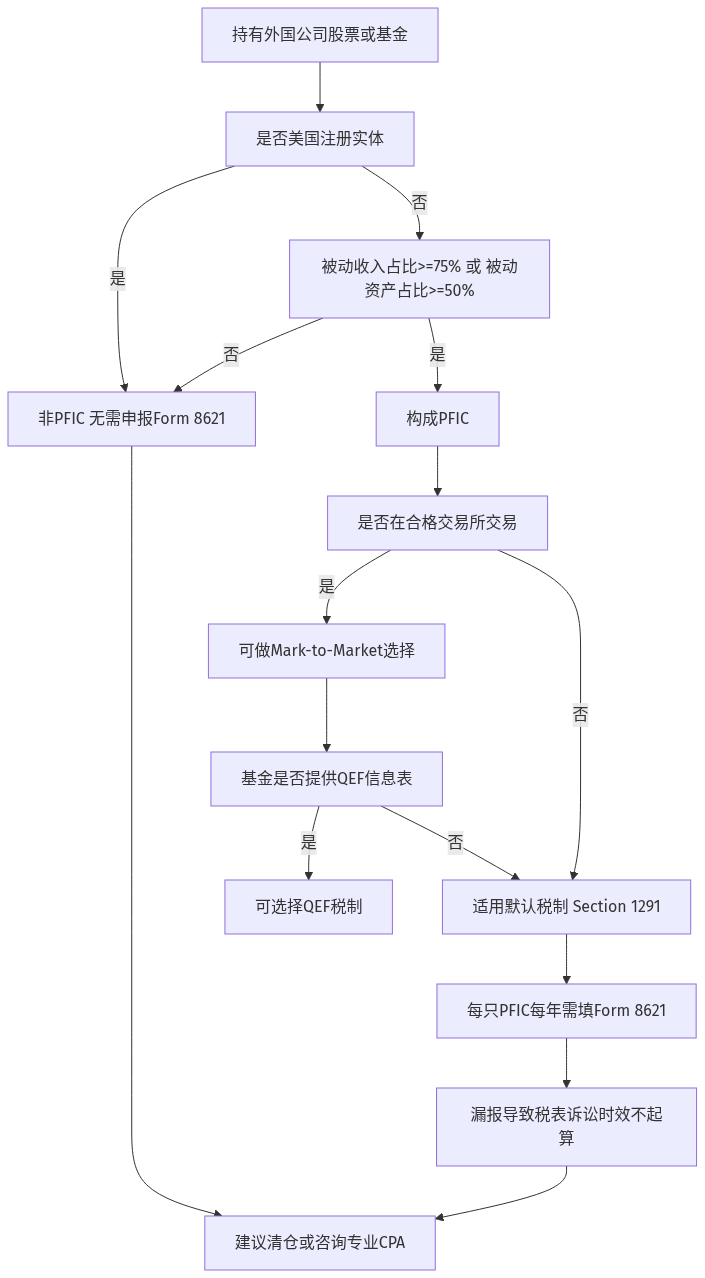
The test for determining PFIC status is quite simple, and meeting either of the following two criteria is sufficient: at least 75% of a foreign corporation's income is passive income, or at least 50% of its assets are passive assets. "Foreign corporation" here refers to an entity organized outside the United States. Chinese mutual funds, bank wealth management products, and money market funds are, in essence, investment entities organized outside the United States, with income and assets derived almost entirely from passive sources such as interest, dividends, and capital gains. As a result, they meet the definition of a PFIC in nearly every case.
Many Chinese investors mistakenly believe that "I bought a principal-protected wealth management product issued by a domestic bank, it's low-risk, so it shouldn't be a PFIC." But the PFIC rules do not look at investment risk or the product's name—they look only at the legal nature of the entity and its asset/income structure. Even if you hold a money market fund (such as Yu'ebao), whose underlying assets are short-term bank deposits and bonds with passive income close to 100%, it still constitutes a PFIC. The only exceptions are directly holding individual Chinese ADR/stock shares, or U.S.-registered ETFs tracking Chinese stocks (such as MCHI or KWEB)—these are not PFICs because they are either direct equity holdings or U.S.-registered funds. However, if you hold a "China-themed fund" that is registered in China, it is still a PFIC.
The determination process can be seen in the diagram below:
Chinese clients in Austin often ask: "I bought a domestic fund years ago and haven't touched it since—do I need to report it?" The answer is yes. As long as you are a U.S. tax resident (whether by green card or by meeting the substantial presence test), holding a PFIC triggers a filing obligation regardless of whether you have sold it. Many people only realize they've stepped into this trap when their CPA asks about foreign investments during their first tax filing.
The Punitive Nature of the Default §1291 Regime: Income Allocation + Highest Marginal Tax Rate + Interest
If you hold a PFIC without making a QEF or Mark-to-Market election, the IRS automatically applies the §1291 Excess Distribution regime. This regime is designed to be extremely harsh: when a PFIC generates distributed income (including dividends, redemptions, and anything deemed an "excess distribution"), the income is assumed to be spread evenly across each year of the holding period. Then, for every year you held the PFIC, you must pay additional tax on the portion of income allocated to that year at that year's highest marginal tax rate, plus IRS-mandated interest (calculated separately for the tax owed in each year).
For example: suppose you bought a domestic fund in 2020 and redeemed it in 2026 with a gain of $60,000, having held it for 6 years. The IRS would divide the $60,000 by 6, allocating $10,000 to each year. Then, for each year from 2020 through 2026, the $10,000 allocated to that year would be taxed at that year's highest marginal tax rate (which could be as high as 37% or more), and interest would be calculated and charged on the tax owed for each year's $10,000. The final tax burden could far exceed the standard 20% long-term capital gains rate, and could even exceed the gain itself. This is why the default PFIC tax regime is called a "punitive tax regime."
Even more alarming, if you never reported the PFIC and simply sold it, the IRS may audit you after you file your return and demand back taxes plus interest. Moreover, as repeatedly emphasized in our Tax Insights column, under the "statute of limitations" rule—if a required form is not filed with the return, the statute of limitations for the entire return never begins to run—this means the IRS can go back and examine your entire PFIC holding history at any point in the future. This is a key risk that many Chinese-speaking CPAs in Austin specifically warn green card clients about.
QEF and Mark-to-Market: Why Are They Basically Unworkable for Chinese Funds?
To avoid the punitive effects of §1291, the IRS offers two elective tax regimes: the Qualified Electing Fund (QEF) election and the Mark-to-Market (MTM) election. But for investors in Chinese funds, both options are essentially unavailable in practice.
The QEF election requires the fund to provide shareholders with an Annual PFIC Statement, which includes detailed data such as the fund's income accrued for the year, income distributed, and tax attributes. Chinese mutual funds, bank wealth management products, and money market funds do not issue information statements that meet U.S. tax law requirements. Even if you proactively contact the fund company, they are almost certainly unable to provide one, because this information would need to be reformatted according to U.S. accounting standards and tax law—an extremely costly undertaking with no commercial incentive for them to do so. Without a QEF statement, you cannot make a QEF election.
The MTM election, meanwhile, requires that the PFIC's shares be traded on a "qualified exchange." Chinese funds (including ETFs listed in Hong Kong) generally do not meet this requirement. The Shanghai and Shenzhen stock exchanges are not considered qualified exchanges. As a result, MTM is also unavailable for Chinese funds. The only exceptions are certain ETFs listed in Canada or Europe, but for domestic Chinese funds, the MTM route is likewise closed off.
The result is that investors in Chinese funds are left with only the default §1291 regime. This is why many experienced Chinese-speaking CPAs in Austin advise clients to liquidate their domestic funds and wealth management products before obtaining a green card, or to hold them under nonresident status instead.
One Form 8621 Per PFIC Per Year: Failure to File Means the Statute of Limitations Never Starts
If you choose to continue holding a PFIC, you must file a separate Form 8621 (Information Return by a Shareholder of a Passive Foreign Investment Company or Qualified Electing Fund) for each PFIC you hold, every year. If you hold three domestic funds, two bank wealth management products, and one money market fund, that means filing six separate Form 8621s each year. Even if a fund makes no distributions and is not sold, a filing is still required (typically noting "No Election" on Form 8621 and reporting zero distributions). The filing deadline aligns with the individual income tax return deadline (including automatic extensions), and late filing carries the same penalty exposure.
But the most serious consequence isn't the penalty—it's the statute of limitations issue. Under IRS rules, if a taxpayer was required to file Form 8621 but failed to do so, the three-year statute of limitations for the entire individual income tax return never begins to run. This means the IRS can audit and pursue back taxes on your entire income for that year at any point in the future—theoretically without limit. For example, if you failed to report a PFIC in 2020 and the IRS discovers this in 2023, it can reopen your 2020 return, and not only pursue back taxes related to the PFIC, but also examine every other item on that return (such as wages, stock transactions, and foreign accounts).
Foreign account reporting (FBAR) and FATCA obligations may also overlap with PFIC reporting. If you hold domestic funds through a Chinese bank account, in addition to Form 8621, you may also need to file FinCEN Form 114 and Form 8938, as described in our FBAR Filing Guide. The complexity of coordinating multiple forms is a major reason many Chinese individuals seek out Chinese-speaking tax preparation services in Austin.
YZ CPA Note
The PFIC rules are among the most commonly overlooked traps in U.S. tax law, especially for green card holders who were born in China and later immigrated to the United States. Chinese mutual funds, bank wealth management products, and money market funds almost all constitute PFICs, and since neither the QEF nor the MTM election is available, taxpayers are left to bear the punitive §1291 tax regime. A separate Form 8621 must be filed for each PFIC every year—otherwise, the statute of limitations for the entire tax return will never close. We recommend that all tax residents holding domestic Chinese investment products carefully review their holdings before filing and assess whether they should liquidate and move funds back to China, or convert to non-PFIC investments (such as U.S.-registered funds or direct holdings of Chinese ADRs/stocks). Clients with a history of unreported PFICs should proactively correct the issue as soon as possible through a compliance filing program (such as the IRS's Streamlined Filing Compliance Procedures or voluntary disclosure) to avoid unlimited exposure to audit risk. If your PFIC holdings are complex, or if you're unsure how to properly complete Form 8621, we strongly recommend consulting a CPA experienced in cross-border taxation. For professional tax assistance, please visit the YZ CPA Services page or contact us.
This article is part of the "Cross-Border Assets and Legacy Planning for Chinese Families" series (Article 2).