
If you're about to receive a U.S. green card, or are preparing to enter the United States on an immigrant visa, there's one move that could be worth more than any investment: selling highly appreciated assets (stocks, funds, real estate back home, etc.) before you officially become a U.S. tax resident, and then immediately buying them back. This isn't speculation — it's using your pre-immigration nonresident status to reset your cost basis ("re-basing"), so you avoid owing the IRS hundreds of thousands of dollars in capital gains tax down the road. At the same time, once your status changes, worldwide income taxation and worldwide information reporting (FBAR, Form 8938, Form 3520, Form 5471, Form 8621, etc.) all kick in. This article draws directly on real cases from Austin's Chinese tax clients to break down the critical timing between "nonresident" and "tax resident" status, along with the CFC/PFIC traps you must avoid ahead of time.
Two Paths to Becoming a U.S. Tax Resident and the Timing of Your First-Year Status
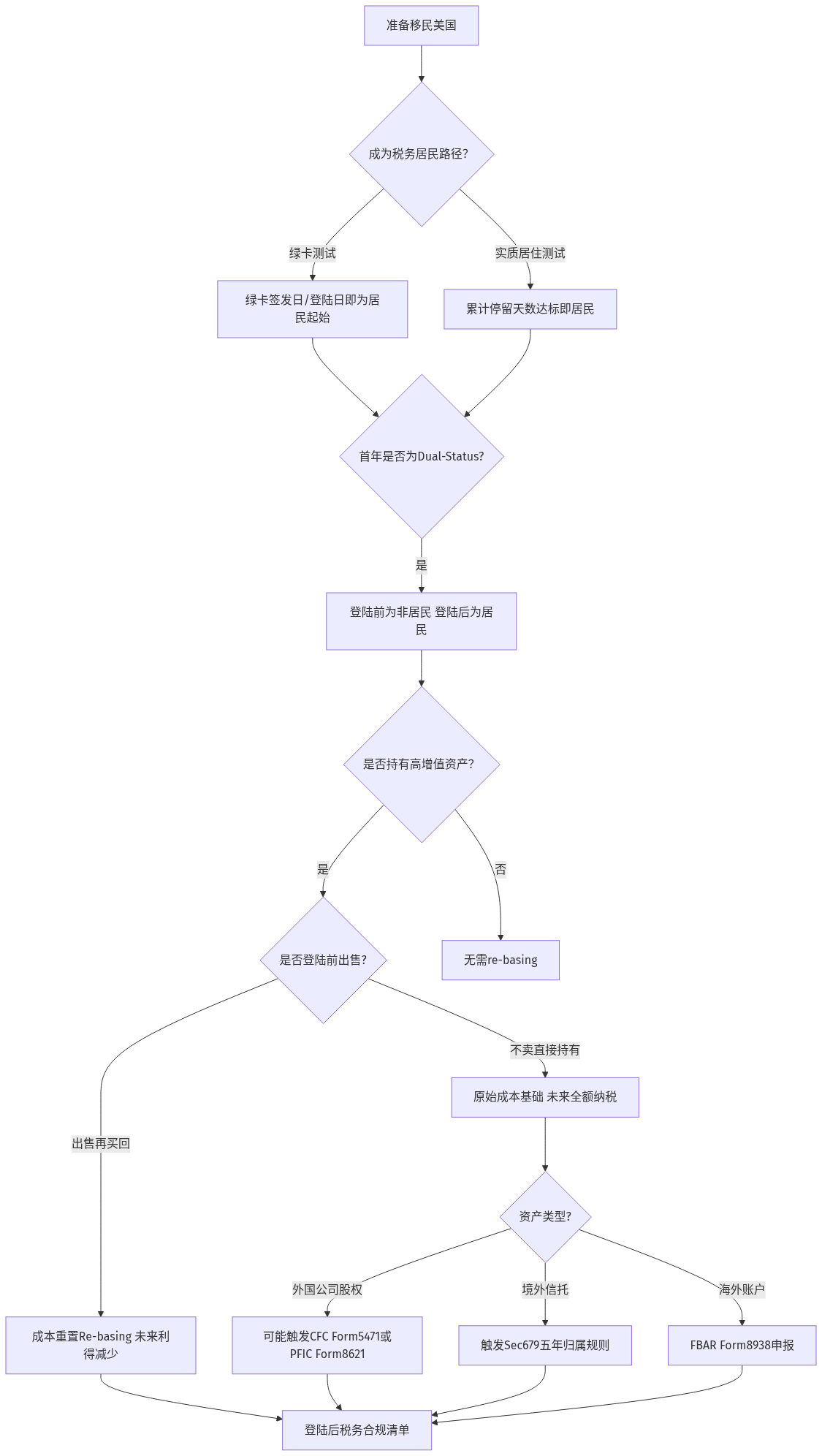
U.S. tax law recognizes two paths to tax residency: the Green Card Test, under which the day you receive your green card is your residency start date; and the Substantial Presence Test, based on the number of days you're physically present in the U.S. (calculated using a weighted formula covering 31 days in the current year plus the two preceding years). For immigrant clients, the Green Card Test is the most common — with the green card issuance date or the date of entry (first arrival on an immigrant visa) marking the start of tax residency.
This timing is critical, because in your first year you're very likely to be a Dual-Status taxpayer: a nonresident before you land, and a resident afterward. You'll need to report worldwide income to the IRS for the resident portion of the year (from the date you receive your green card through year-end), while foreign income earned during the pre-immigration nonresident period generally does not need to be reported to the U.S. However, be aware that if you spend a significant number of days in the U.S., you may trigger the Substantial Presence Test early, causing your tax residency to begin before your green card date. It's advisable to carefully calculate your days before immigrating, or consult an Austin Chinese-speaking CPA, to avoid unexpectedly becoming a tax resident ahead of schedule.
Worldwide Income Taxation and the Information Reporting Web: FBAR, 8938, 3520, 5471, 8621
Once you become a U.S. tax resident, all of your worldwide income becomes taxable to the IRS, and your foreign financial assets and certain entity interests must be reported through multiple forms. First is the FBAR (FinCEN Form 114), which reports foreign bank accounts (including joint accounts and accounts over which you have signature authority), required whenever the combined balance of all your foreign accounts exceeds the threshold published by the IRS for that year. Next is Form 8938 (Statement of Specified Foreign Financial Assets), which reports foreign financial assets (such as stocks, funds, insurance policies, and trust beneficial interests) — the threshold is higher, but the scope of coverage differs. Both forms need to be tracked simultaneously; neither can be skipped.
If you hold shares in a foreign corporation or an interest in a foreign partnership, you may trigger Form 5471 (Information Return of U.S. Persons With Respect to Certain Foreign Corporations) or Form 8621 (Passive Foreign Investment Company reporting). If a foreign trust is involved, you'll need to file Form 3520 (Annual Return To Report Transactions With Foreign Trusts and Receipt of Certain Foreign Gifts) and Form 3520-A. Compliance costs for these forms are extremely high, and penalties for late filing are severe. For example, failure to file Form 5471 can result in a penalty starting at $10,000, continuing every 30 days thereafter. That's why you should assess your overseas asset structure before immigrating, to determine which assets will fall within reporting requirements once your status changes. One point Austin Chinese tax clients frequently overlook: even if you become a resident under the Green Card Test, foreign corporate shares you already held before landing can immediately become subject to CFC or PFIC status, requiring annual reporting. For more details on reporting foreign accounts, see our FBAR Filing Guide.
The Core Move: Selling and Repurchasing Assets Before Immigration to Reset Cost Basis (Re-basing)
The single most valuable piece of pre-immigration planning is using your nonresident status to sell highly appreciated assets and immediately buy them back. Why? Because U.S. tax law applies a "tax cost basis" to assets held by a tax resident, and the moment you shift from nonresident to resident, your asset's cost basis does not automatically adjust to its fair market value on your arrival date — there's no automatic "step-up" in basis. If you simply hold onto appreciated assets and then land, when you eventually sell, the U.S. will calculate capital gains starting from your original purchase cost. But if you sell before landing (for example, selling stocks or funds), as a nonresident you generally don't owe U.S. capital gains tax (unless the asset is connected with a U.S. trade or business), and you can then buy the asset back at its pre-immigration high market value — so going forward, your U.S. cost basis becomes this new purchase price, effectively "washing out" all the prior appreciation.
Here's an example: say you bought shares of a Chinese company stock in 2015 for $100,000, and it's now worth $1,000,000. If you land with the green card first and later sell it for $1,200,000, your U.S. taxable gain is $1,100,000 ($1,200,000 minus $100,000). But if you sell before landing (no U.S. tax owed as a nonresident), you pocket $900,000 in gains tax-free, then immediately buy back in at $1,000,000 — your new cost basis becomes $1,000,000, so when you later sell at $1,200,000, you'll only owe tax on $200,000 of gain. The difference is stark. The same logic applies to real estate, cryptocurrency, private equity funds, and more. But be careful: if the asset is a Passive Foreign Investment Company (PFIC) — for example, a non-U.S. mutual fund or certain insurance products — you'll need to file Form 8621 every year after landing, and gains will be taxed at the highest rate under the "excess distribution" rules, which is extremely unfavorable. That's why PFIC-type assets should ideally be liquidated before you immigrate.
For clients holding equity in domestic (Chinese) companies, there's a key risk to watch for: if the company you hold shares in is treated as a "Controlled Foreign Corporation" (CFC), once you become a U.S. person you'll need to file Form 5471 annually, and may even face immediate taxation on Subpart F income. PFIC and CFC status can sometimes overlap — for example, if you hold a small stake (under 10%) in a domestic listed company that has no active business, it may be classified as a PFIC. Selling the equity before landing, or restructuring (such as converting into U.S. company shares), can help you avoid this. But when changing corporate equity holdings, you also need to consider China's foreign exchange controls and exit tax issues.
Foreign Trusts Before Immigration: The §679 Five-Year Lookback Attribution Rule and Timing Choices
If you established a foreign trust before immigrating — or transferred assets to one, such as a family trust or offshore trust common in China — U.S. tax code §679 contains a special "lookback" rule for new immigrants that requires extra caution. Under §679(a)(4), if you become a U.S. resident within 5 years after transferring assets to a foreign trust — that is, any transfer completed within this 5-year lookback window before landing — that transfer will be treated as having occurred on your "residency starting date," and §679 will apply from the moment you become a resident. Pay special attention to the direction of this rule: this 5-year period runs forward from the transfer date to your landing date as a lookback window — it is not a grace period or exemption period that begins after you land.
Once §679 applies, as long as the trust has a "U.S. beneficiary," you as the Grantor will be treated as the owner of the portion of the trust corresponding to the assets transferred, and the trust's corresponding income will flow directly onto your personal U.S. tax return under the grantor trust rules — even if the trust terms provide for no distribution that year. Critically: this attribution does not automatically end after 5 years — it continues until the trust no longer has any U.S. beneficiaries at all (§679(a)(1)). In other words, the 5-year window only serves to "pull in" pre-immigration transfers under §679's threshold condition — it is not an exemption that automatically expires. In the meantime, the foreign trust will typically also need to file Form 3520 and Form 3520-A annually, with high compliance costs and steep penalties for late filing.
Mitigation strategies include amending the trust terms before immigrating so it's no longer classified as a grantor trust, or distributing or liquidating the trust assets ahead of time. Note, however, that adjusting a trust may involve gift tax and cross-border legal risks. As for timing, it's generally advisable to complete a full trust review at least six months before your green card is approved, since once your tax residency status is established, any subsequent changes will trigger U.S. tax consequences. Additionally, if your immigration timeline has some flexibility (for example, choosing to land before or after the end of the tax year), try to land before year-end to reduce the complexity of first-year dual-status filing. For more detailed case studies and timing planning, see our Chinese Tax Filing Guide.
YZ CPA Note
Pre-immigration tax planning isn't as simple as just "selling assets" — it requires a comprehensive assessment of asset types, ownership structures, reporting costs, and future liquidation plans. Here are three priorities every prospective green card client must consider first: First, take stock of all your overseas assets as early as possible, determine which ones will trigger FBAR, Form 8938, 5471, 8621, or 3520 reporting after you land, and assess the compliance costs. Second, strictly execute the "sell before landing, then buy back" strategy for highly appreciated financial assets, and be sure to liquidate any PFIC-type assets in particular. Third, if foreign trusts or holding companies are involved, consult a tax professional about restructuring at least 6 months before you immigrate. Because the IRS adjusts exemption amounts and reporting thresholds for inflation each year, please refer to the figures published by the IRS for the year you actually land. We recommend starting your planning 6-12 months before immigration to leave enough time to execute transactions and changes. For professional tax assistance, please visit our YZ CPA Services page or contact us.
This article is part of the "Cross-Border Assets and Legacy Planning for the Chinese Community" series (Article 1).