
This article assumes you already know what FBAR is — if you don't, start with our Complete Guide to FBAR Filing. This piece focuses on the 5 types of overseas accounts that are most often missed in practice and most likely to be caught by the IRS, along with the Streamlined voluntary disclosure process for correcting past omissions. Many Chinese Americans have been penalized precisely because they missed one of these 5 account types — even though a dedicated penalty-reduction pathway exists.
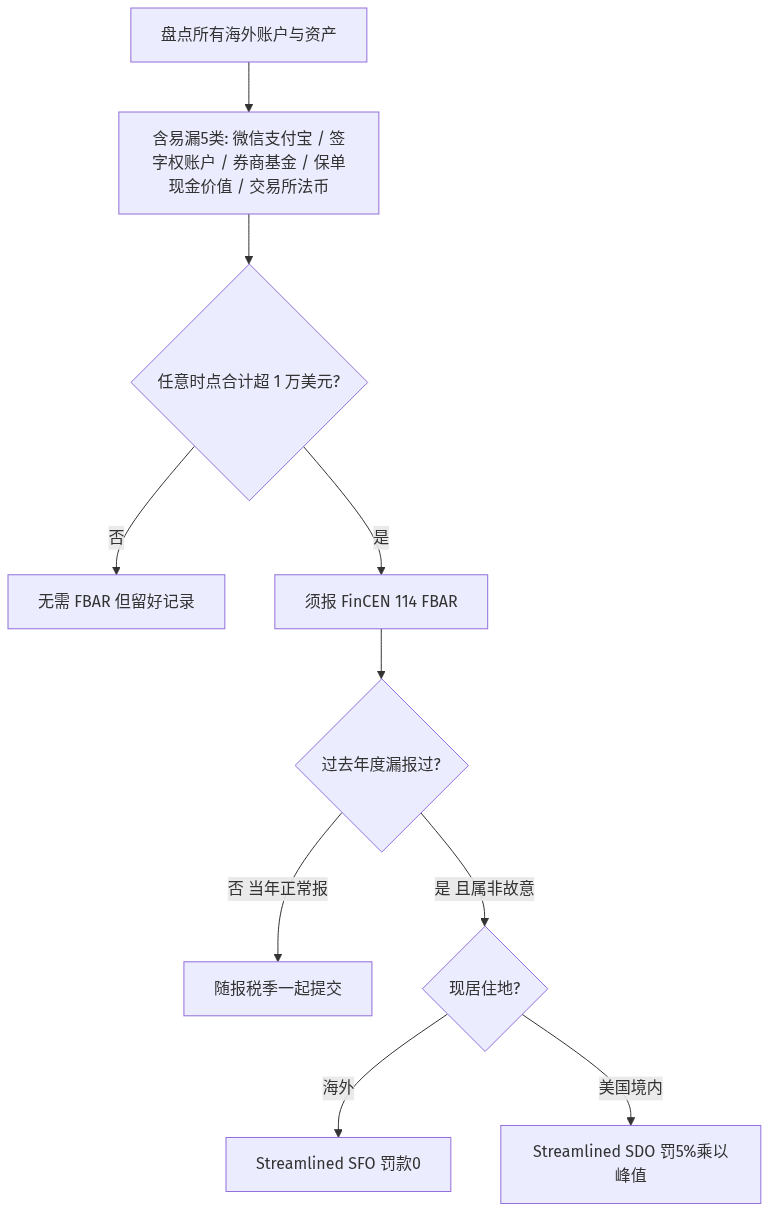
Here's some context first: most clients dutifully report the ”obvious” accounts — ICBC, China Merchants Bank, CITIC Securities — but miss the 5 categories below. If the IRS catches an omission on its own, non-willful failures are penalized per year: the Supreme Court's 2023 Bittner decision confirmed the penalty applies ”per annual FBAR filing” rather than ”per account,” with a base penalty of $10,000 (adjusted annually for inflation, per the current year's published figure); willful violations can reach 50% of the account balance, and multi-year totals can easily exceed $50,000. The chart below lays out whether you need to file and how to fix a past omission:
Category 1: WeChat Wallet / Alipay Balances
This has been, hands down, the most commonly missed category over the past couple of years. FinCEN's definition of a ”financial account” includes any account with an institution engaged in banking or related business — both WeChat Pay (Tenpay) and Alipay qualify, since they hold your fiat currency balance and offer transfer functions, much like a bank. The reporting threshold is triggered when all your overseas accounts combined exceed $10,000 (roughly RMB 73,000) at any point during the year, converted to USD using the exchange rate on the date of the highest balance. A few traps to watch for:
- Chinese New Year red envelope spikes: balances can briefly surge to tens of thousands of RMB between New Year's Eve and the fifth day of the lunar new year.
- Transit funds from parents: even if your parents' down-payment transfer only passes through your WeChat wallet overnight, it still counts toward that year's peak balance.
- Business receipts: ad revenue from a personal media account or proceeds from overseas purchasing agent work can quietly add up to tens of thousands of RMB without you noticing.
- Alipay's Yu'ebao money-market fund is also a financial account and counts as well.
The correct approach: report WeChat Wallet and Alipay as two separate accounts, listing the account holder as Tenpay (Shenzhen) and Ant/Alipay (Hangzhou) respectively, converting using the exchange rate on the date of the year's highest balance.
Category 2: Accounts You Have Signature Authority Over But Don't Own
FBAR doesn't only cover accounts you ”own” — if you have signature authority or other authority over an account, you must report it even if the money isn't yours. The most common scenarios: managing an elderly parent's domestic account (you know the password and help with transfers); serving as an executive at a company in China with signature authority over its corporate account; managing a Chinese account held in your spouse's name; or a joint account with a sibling. When filing, check the box indicating ”I have signature authority or other authority over this account,” list yourself as the filer, and report the full balance (not a prorated share).
Here's a real example: an engineer managed his father's real estate investment company account in China (he had signature authority), with a balance of over RMB 2 million. His own personal accounts were small and never triggered FBAR, but he overlooked this signature-authority account and went unreported for 3 years. After going through Streamlined, his penalty was reduced to zero — but if the IRS had caught it on its own, that would have meant penalties starting at $30,000 for the 3 years. There's a narrow exemption for a pure employment relationship (an employee at a large company whose signature authority is limited to certain transactions), but in most cases the account still needs to be reported — when in doubt, report it; that's safer than leaving it out.
Category 3: Funds / ETFs / Wealth Management Products in Brokerage Accounts
Many people assume FBAR only covers bank cash accounts, but it actually covers ”financial accounts” broadly — including bank deposits, brokerage accounts, fund/ETF holdings, bank wealth management products, and the cash value of insurance policies (covered in the next section). A few traps: the savings account and the ”funds” section within the China Merchants Bank app need to be reported separately; Hong Kong, U.S., and A-share holdings within a single Futu or Tiger Brokers account count as one financial account and should be reported at their highest combined value; and any brokerage account, such as CITIC Securities or Guotai Junan, needs to be reported.
There's a compounding trap here: fund shares held directly in China not only need to be reported on the FBAR, but many also qualify as PFICs (Passive Foreign Investment Companies), triggering an additional Form 8621 filing and punitive tax treatment — that's a separate set of rules, covered in detail in our Guide to PFICs and Form 8621 for Chinese Funds. When reporting, list the brokerage name, account number, and the highest USD value during the year.
Category 4: Cash Value of Life Insurance Policies from China / Taiwan
This is the second-biggest blind spot for Chinese Americans. Whole life, universal life, and investment-linked insurance policies purchased in mainland China or Taiwan fall within FBAR's scope as long as they have a ”cash value (Cash Surrender Value — the amount you'd receive if you surrendered the policy today).” The threshold is based on the cash value, not the death benefit — a whole life policy with RMB 10,000 in annual premiums paid over ten years typically has a cash value of RMB 80,000 to over 100,000, comfortably exceeding the $10,000 threshold. Pure term life insurance has no cash value and doesn't need to be reported.
When reporting, list the insurance company's name and policy number along with the highest cash value during the year; if your total overseas assets reach the threshold, you may also need to file Form 8938. Many people miss this because insurance agents in China never mention U.S. compliance requirements, and clients assume ”buying insurance isn't the same as opening an account” — but the IRS treats a policy with cash value as a financial account. This is one of the areas where we've seen clients most frequently misled. For a more complete discussion of the tax treatment of these policies (including the §7702 determination), see the cross-border disclosure section of our Complete Guide to Tax Filing for Chinese Taxpayers.
Category 5: Fiat Currency Balances on Cryptocurrency Exchanges
The rules on how cryptocurrency relates to FBAR are still evolving, but one part is settled: fiat currency balances held on an exchange fall within FBAR's scope. If you hold USD, USDT, USDC, or other fiat balances on a non-U.S.-registered exchange such as Binance.com (international), OKX, or Bybit, this is treated much like having a foreign bank account — FinCEN considers it a reportable overseas financial account, and the same $10,000 combined threshold applies.
Whether pure cryptocurrency holdings (only BTC/ETH, no fiat) need to be reported on FBAR remains unsettled (FinCEN proposed requiring this in 2020, but no final rule has been issued). The conservative approach for now is to report it anyway — there's no downside to ”over-complying” with FBAR. FATCA's Form 8938, however, already explicitly includes cryptocurrency held on overseas exchanges, and it must be reported once your overseas assets reach the threshold. For a more complete discussion of digital asset tax treatment, see our Complete Guide to Digital Asset Tax Filing.
What to Do If You've Missed Filings: The Streamlined Voluntary Disclosure Process
If you've non-willfully failed to file FBARs in past years, the IRS offers a penalty-reduction pathway called the Streamlined Filing Compliance Procedures. It's designed for people whose omission was genuinely non-willful (they didn't know about the requirement, or mistakenly believed a particular account didn't count), who are willing to file the past 6 years of FBARs and amend the past 3 years of tax returns, and who can sign a certification of non-willful conduct. The level of penalty relief:
- Streamlined Foreign Offshore Procedures (SFO): for those who meet the foreign residency requirement, the penalty is zero — you only need to pay the tax actually owed.
- Streamlined Domestic Offshore Procedures (SDO): for U.S. residents, the penalty is 5% of the highest year-end balance of overseas assets across the 6-year period — far lower than the cumulative non-willful penalties the IRS would assess per year if it caught the omission on its own.
The general process: gather statements and peak annual balances for all overseas accounts over the past 6 years; amend the past 3 years of Form 1040 (reporting overseas interest income and Form 8938 as needed); file the past 6 years of FBARs marked ”Streamlined”; draft a certification of non-willful conduct (Form 14653 or 14654); and mail everything together to the IRS's Streamlined processing unit, then wait 6–12 months. We strongly recommend working with a professional on this — a poorly drafted non-willful certification can lead the IRS to conclude the conduct was willful, which would push the penalty up by an order of magnitude. This is a high-risk document.
When to Seek Professional Help
- You want to catch up on missed FBARs but worry about drawing unwanted attention: Streamlined is a time-limited compliance pathway that's far safer than gambling on ”the IRS won't catch it.”
- You have ”gray-area” accounts like WeChat, Alipay, an exchange account, or an overseas insurance policy and aren't sure whether they need to be reported: a single consultation can give you a complete inventory and risk assessment.
- You have signature-authority accounts (company, parents, family) and are unsure where the disclosure boundary lies.
FBAR Real-World FAQ
Q: My WeChat Wallet balance is around $7,000 — do I need to report it?
It depends on the total — the threshold is $10,000 combined across all overseas accounts. $7,000 in WeChat alone is under the threshold, but if adding other accounts (bank cards, brokerage accounts) pushes the total over $10,000, everything must be reported. Once the threshold is triggered at any point during the year, all accounts must be reported for the full year.
Q: I manage my parents' domestic account (I have the password, but the money isn't mine) — do I need to report it?
Yes, report it under signature authority. List your own name as the filer and your parents' name for the account, and report the full balance. The penalty for failing to report this is just as severe as failing to report your own account.
Q: My brokerage account holding Hong Kong stocks has a balance of $30,000, but I've never actually traded — does it count for FBAR?
Yes. FBAR doesn't distinguish between active trading and dormant accounts — if the account exists, you have access to it, and the balance exceeds the threshold, it must be reported.
Q: My insurance agent in China told me I don't need to report my whole life policy in the U.S. — is that correct?
No, that's incorrect. Insurance agents in China aren't familiar with FBAR/Form 8938 rules. A whole life policy with a cash value over $10,000 must be reported on FBAR, and Form 8938 may also be required.
Q: I only hold BTC/ETH in crypto and no fiat currency — do I need to report FBAR?
The rules aren't finalized: FinCEN proposed requiring this in 2020, but no final rule has been issued. The conservative approach is to report it anyway. Form 8938, however, already clearly requires reporting.
Q: I've missed 5 years of FBAR filings — what happens if I catch up now?
The Streamlined pathway is available: if the failure was non-willful, the penalty is zero if you live abroad, or 5% of your highest single-year balance if you live in the U.S. — much cheaper than if the IRS caught it on its own. After the Bittner decision, non-willful penalties are assessed per annual filing, not stacked per account, but the total across multiple years can still add up considerably. We recommend proactively pursuing Streamlined.
Q: What if I missed the April 15 FBAR deadline?
FBAR automatically extends to October 15, so missing April 15 isn't actually a problem — it's only considered late after October 15. If a late filing is non-willful and you file proactively, the IRS is generally lenient.
Q: I made a mistake on my FBAR (wrong balance / missed an account) — how do I fix it?
Resubmit a corrected FinCEN Form 114, checking the ”Amended” box and stating the reason for the correction. A routine correction typically doesn't trigger any penalty.
YZ CPA Note
The areas where FBAR omissions occur most often are almost never ”forgot to report ICBC” — they're these 5 account types that you may never have thought needed to be reported: e-wallets, signature-authority accounts, brokerage funds, insurance cash value, and exchange fiat balances. The good news is that the remediation pathway (Streamlined) is well-established, and the vast majority of omissions by Chinese Americans are non-willful — proactively going through the proper process can usually keep the risk under control. What's dangerous is continuing to delay, or taking matters into your own hands with a ”quiet catch-up” filing. We recommend doing an annual inventory of your overseas accounts — this makes it easier to determine your filing obligations, and it's also the strongest evidence you can have if you ever need to catch up on filings in the future.
If you'd like a professional assessment of your FBAR filing obligations or help developing a catch-up filing plan, please visit our YZ CPA Services page or contact us. For more topics, see our Tax Insights section and Tax FAQ.